
The Rouge River Watershed is home to more than one million people and encompasses 466 square miles, running through the most densely populated and urbanized land area in southeast Michigan, including the City of Oak Park.
The Rouge River is a tributary to the Detroit River and its four branches total approximately 126 miles of waterways and includes more than 400 lakes, impoundments and ponds.
More than 50 miles of the river flows through public parklands, making the Rouge River one of the most publicly accessible rivers in the country.
The purpose of the Alliance of Rouge Communities (ARC) is to encourage watershed-wide cooperation and support to restore the beneficial uses of the Rouge River for area residents while meeting water-quality permit requirements.
Learn more about ARC at: ARC Rouge River Watershed
Rouge River Project Overview
Everyone who lives and works in the Rouge River Watershed has the potential to pollute the river or help restore it to health.
If not treated properly, water travelling through storm drains can release pollutants into our waterways.
When contaminants like oil or antifreeze are dumped down a storm drain, we pollute the river? Fertilizers, pesticides, oil and grease from cars and bacteria from pet waste can also pollute.
By takin the following steps, you can help prevent pollution from entering the Rouge River:
- Lawn care - Keep fertilizers, pesticides and herbicides off paved surfaces and out of drainage paths. When choosing a fertilizer, select a slow-release formula. Fertilize in September or October to promote root growth rather than top growth.
- Automobile maintenance - Direct polluted wash water away from streets and storm drains. Instead of washing your car in the driveway or street, wash your car on your lawn or better - go to a car wash.
- Animal waste - Clean up animal waste before it washes into the storm drain. By throwing it in the trash, you prevent bacteria from entering the Rouge.
- Home care - Disconnect downspouts from sewer systems and direct them to vegetated areas away from building foundations. When cleaning up spills and leaks do not use your hose as a broom.
- Toxic materials - Properly dispose of household hazardous waste and call your local community to find out if they have a collection day. An even better solution is to use non-toxic alternatives whenever possible.
- Get Involved - Citizens can also join Friends of the Rouge and/or participate in Rouge River Watch, storm drain stenciling or other Rouge-friendly neighborhood activities. Call (313) 792-9900 for information.
Friends of the Rouge
Friends of the Rouge (FOTR) is a nonprofit 501(c)(3) organization founded in 1986 to raise awareness of the need to clean the Rouge River in southeast Michigan.
The mission of the Friends of the Rouge is to restore, protect and enhance the Rouge River watershed through stewardship, education and collaboration.
For more information contact the Friends of the Rouge
4901 Evergreen Road, APC
Dearborn, MI 48128
(313) 792-9900
https://therouge.org/about-us/
Friends of the Rouge Events
The Friends of the Rouge River Project host many events throughout the year, including the Raise One for the Rouge, Land + Water WORKS Coalition, Bug hunt events and trainings, Rouge Rescues, fish survey events, Rouge paddling trips, Free Press Marathon, Merriman Hollow work and more. To view their calendar, visit Friends of the Rouge Event Calendar.
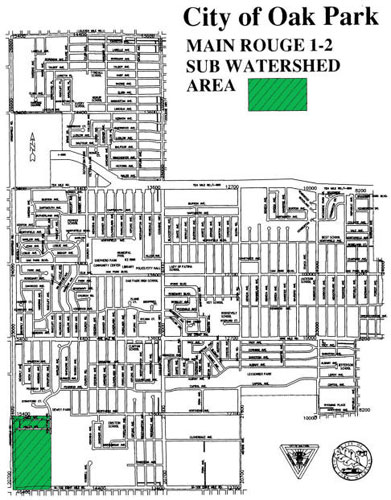
Rouge River Watershed Map
The Oak Park portion of the watershed is indicated below.
Stormwater Management Plan
The following is the City of Oak Park's oak-park-stormwater-management-plan-2025.pdf for the River Rouge Watershed area (Greenfield and Eight Mile Road.)
This file includes our permit application for Discharge of Stormwater to Surface Waters of the state from a Municipal Separate Storm Sewer System.
The file also includes the standard operating procedures for enforcement response, post-construction stormwater runoff control, and general procedures for pollution prevention and good housekeeping for the River Rouge Project.
Report Illicit and Illegal Discharges
Careless or intentional acts of illicit and illegal dumping are expensive to remedy and have long-term effects on the health of the Rouge River.
These can include toilets connected to storm sewers, laundry waste discharging to a drain, swimming pool backwash water discharged to a storm sewer or polluting material on land that enters storm sewers.
If you see an illicit or illegal discharge, report it by calling the Michigan Department of Environmental Quality Pollution Emergency Alerting System at (800) 292-4706.
Then call the appropriate county:
Oakland County Water Resource 24-Hour Pollution Hotline at (248) 858-0931
Wayne County at (734) 222-3880
Washtenaw County at (888) 223-2363
If you see dumping, call 9-1-1.
For more information, visit https://therouge.org/illicit-and-illegal-discharges/.
Oakland County Water Resource Commission
The Oakland County Water Resource Commissioner's Office provides quality water supply, drainage systems and sewage disposal systems in a way that keeps the environment safe and promotes responsible growth.
To learn more about the responsibilities of the Water Resource Commissioner's office, visit Oakland County Water Resource Commissioner or contact Water Resource Commissioner Jim Nash at (248) 858-0958 and wrc@oakgov.com.
Emergencies:
Water and Sewer 24-Hour Emergency - (248) 624-6366
For more information:
Oakland County Water Resource Website, visit https://www.oakgov.com/water/
Information on the Oakland County Water Commissioner, visit https://www.oakgov.com/water/Pages/about/default.aspx
More Information on Water Pollution, visit Illicit and Illegal Discharges.
Great Lakes Water Authority
On Jan. 1, 2016, the City of Detroit, the counties of Macomb, Oakland and Wayne, and the State of Michigan formed the Great Lakes Water Authority (GLWA).
The GLWA manages regional water and wastewater services to retain control of water and sewer services.
The GLWA has six board members, including two from the City of Detroit, and one each from Wayne, Oakland and Macomb counties; and one from the State of Michigan.
Their priorities are to include water quality and collaboration with member communities, highlight infrastructure improvements, charge structures and make decisions on the environmental approach.
Great Lakes Water Authority
735 Randolph, Suite 1900
Detroit, MI 48226
General information: (844) 455-4592
Email: info@glwater.org
Helpful Links
Environmental Protection Agency
Michigan Department of Environment, Great Lakes and Energy--EGLE (Formerly the MDEQ)