
Utility Billing and Collections
On May 18, 2026 water and sewer rates were approved by the city council. The new rates began July 1, 2026.
Water and sewer charges are based on your water consumption.
To see the current charges, visit the city's fee schedule.
Your City of Oak Park utility bill is due on or around the 20th of each month. The exact date may shift by up to three business days depending on weekends, federal holidays and U.S. Postal Service delivery schedules.
The Utility Billing Division handles billing and collection for:
- Water
- Sewer
- Stormwater runoff
- Infrastructure charges
- Rubbish collection
- Industrial waste control
Staff are also responsible for reading and maintaining water meters and assisting residents with identifying potential water leaks within their homes.
How Utility Bills Are Structured
A sample bill based on a typical residential monthly bill is shown below:
- Typical Water & Sewage Units = $7
- Water Consumption = $42.21
- Sewage Disposal = $45.50
- Infrastructure (Average) = $5
- Typical Residential Stormwater Runoff (Average) = $29.08
- Rubbish Collection = $12.91
Total = $134.70
Stormwater billing
The City of Oak Park bills stormwater and water and sewer charges separately. All property owners incur a separate line-item cost for stormwater utility fees.
Stormwater Fee Overview
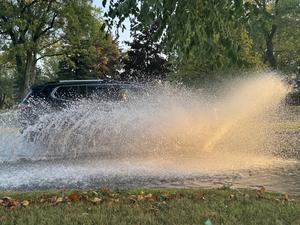
Stormwater is charged to Oak Park's water and sewer customers because when it rains, surfaces drain water into the City's sewage system. This is called runoff. Runoff can enter the system in a number of ways, such as surface drainage into public structures, direct connections from private systems, and infiltration through the ground.
Stormwater is charged based on each customer's unique contribution to the City's overall runoff into our combined sewage system. This means that each property is responsible for paying for its fair share of a rain event. A customer's fair share of the City's total runoff potential, otherwise known as a customer's runoff potential, is calculated based upon the size of each property as well as how much pervious and impervious surface area each property has.
Pervious surfaces allow water to seep into the ground. This includes dirt, grass, gardens, mulch, shrubs, trees, and other greenery. Impervious surfaces do not allow water to seep through but instead cause water to drain directly into the City's sewer system. This would include concrete sidewalks, driveways, other pavement, and structures such as houses, backyard sheds, and commercial buildings.
Calculating Runoff Potential
To calculate each water customer's runoff potential, the city studied pervious and impervious surface area for each property in Oak Park. An aerial assessment with infrared scanning was used to determine the pervious and impervious surface area of each lot That data was then used in conjunction with Oakland County parcel data to calculate runoff potential for each property in the city.
The potential runoff for a property is the pervious area of the property multiplied by a factor of 0.15 plus the impervious area of the property multiplied by a factor of 0.90.
Runoff Potential = PA x 0.15 + IA x 0.90
PA = Pervious Area
IA = Impervious Area
Pervious and impervious surfaces are weighted much differently since an estimated 90 percent of stormwater originating on an impervious surface discharges into the sewage system. It is estimated that only 15 percent of stormwater originating on a pervious surface runs into the system.
Use the following forms to apply for a reduction of your stormwater charges:
- Rain Barrel Residential Stormwater Credit Application.pdf
- Rain Garden Residential Stormwater Credit Application.pdf
- Stormwater Commercial Credit Application.pdf
- stormwater-impervious-surface-appeal-application.pdf
The Utility Billing Office is open:
- Mondays through Thursdays from 8 a.m. to 5 p.m.
- Every other Friday from 8 a.m. to 4 p.m.
For assistance, call (248) 691‑7470.
If you have a water‑related emergency after business hours, call the Department of Public Safety at (248) 691‑7520.